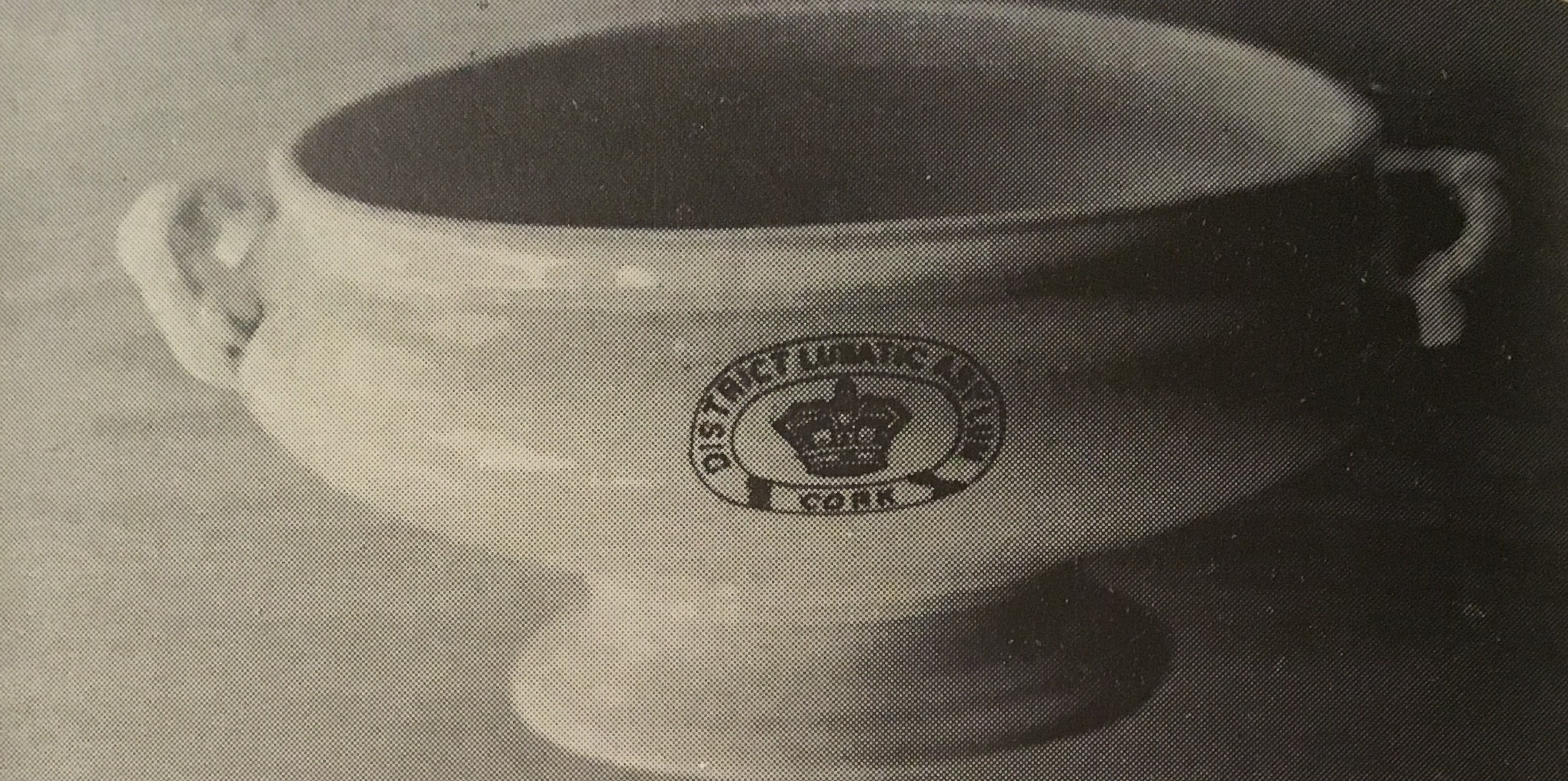
1868
Michael Looney. Watchman – Appointed May 1868. Michael married Kate Mahony on 30 September 1871 at the North Cathedral. He describes himself as a ‘warder’. His father – Daniel – was a labourer. Kate worked in the Asylum as well. Her father is Michael and he is a labourer. The marriage was witnessed by Edward Gregg and Hannah Murphy.
Already the house was overcrowded. Originally built to accommodate 500 patients, the asylum within 18 years was now home to 525 people. Things were going nicely in the asylum according to Dr Power. The inmates were well clad and comfortable, fires were lit in the dayroom (this was January) and the idiotic and epileptic divisions were heated at night. That Power referred to the heating of these wards indicates that other wards within the institution remained unheated. It was now suggested that a musical band should be formed in the asylum. The protestant Archbishop had visited several asylums in England and found that “music had an important and most beneficial effect on the condition of patients”. In Richmond (Grangegorman) a very fine band was organised – composed of patients but now in Cork he was proposing that the staff should form the band. He pointed out that there was already a music teacher employed to teach the patients . It would be easy to form a band. Dr. Power was delighted with the proposal. He noted that at a recent dance organised for the patients, the band master did not turn up and the dance had to be abandoned. If the asylum had its own band, incidents like this could be avoided [Cork Examiner January 11th 1868 p3].
In an interesting case that tells us much about attitudes towards mental illness in 1868 a report appeared in the Examiner. A person in Queenstown whose “prominent symptom was reported labouring under the delusion that Jesus Christ had given him a special appointment” was described by the board as “a mere delusion” and did not meet the criteria for admission because the case was not violent. What is remarkable here is that the views of a lay member of the board seemed to carry equal weight as the view of the professional doctor, Thomas Power. Power considered it a “serious case” but the view of the board member carried the day. A further case was discussed by the board. This time a female was “constantly talking of her soul and thinking she will be damned”. Dunscombe said “if every person who talked about her soul were deemed fit for a lunatic asylum, the house would be soon crowded (laughter)”. However, in this case the applicant was stated to be “occasionally violent” which meant she had to be admitted. [Cork Examiner April 18th 1868 p3]
By September, Dr. Power had made out a list of “quiet and inoffensive patients who might without inconvenience be transferred to their respective Unions (Workhouses) to save expenses”. In accordance with the admission criteria that people seeking admission must be “dangerous lunatics”, patients who no longer exhibited signs of violence and, importantly, who were paupers, were now considered appropriate cases for transfer to the Workhouse. There is no consideration here that the asylum offered anything other than containment of the mentally ill.
Nor should we see the life of the asylum isolated from the great movements of contemporary society. 1867 was the year of the Finian Rising and the asylum could not, of course, escape its influence. On the night of the 6th of March 1867, JF Kearns had joined the rebellion. The attack on Ballyknockane was unsuccessful but Kearns was given up by an informer as a member of the attacking party. Kearns was sentenced to 15 years penal servitude for his trouble “ a sentence of extreme severity considering the circumstances of the case”. His mother writing to the authorities learns that “his bodily health is good but his mind has given way under the isolation and discipline of prison life”. Kearns, a Corkman, is now confined to Broadmore Lunatic Asylum [ The Nation October 3rd 1868 p7].
If we can see in January 1868 how open fires kept the wards warm, one would be surprised that there was never an outbreak of fire. Throughout the entire history of the Irish asylum history there was never a serious fire causing multiple deaths. In 1868, the Examiner reported that the “Ohio Lunatic Asylum at Cleveland has destroyed by fire and that six patients were burnt to death” [Cork Examiner November 21 1868]
In September 1868, at the Richmond Asylum, the staff decided to try something different. They decided to have a sports day. “Assembled on the lawn and adjacent grounds of the asylum were over one thousand lunatics of both sexes, engaged in sports, which, while calculated to cheer and draw them back to the common interest of humanity ..” “On the lawns were a number of tables on which the prizes of the winners of the outdoor sports were exhibited.. we do not give the names of the winners as the competitors were all lunatics, many of whom will be restored to the world by the judicious treatment which they are undergoing”. The programme was as follows; race at 2 0’Clock – 250 yards, three prizes. 8 ozs, 4ozs, 2ozs tabaco with pipes. Aunt Sally for women, books and ribbons given as prizes.
Michael Looney. Watchman – Appointed May 1868
1869
John Lynch. Appointed 15.11.1869. 20 years. Appointed 15.11.1869. Hall Porter. Promoted 1st Class Attendant 15.2.92. Charge Attendant 15.6.1897. John married Mary Gillivan of 12 Tobin Street on 13 Feb 1872. She describes herself as a ‘servant’. John describes himself as a ‘keeper’.. His father – Denis – deceased – was a labourer. Her father – John – was a butcher. The wedding took place in SS Peter & Pauls and was witnessed by Elizabeth Kidney and ? Sweeney.
In the Cork Union (Workhouse) – present day St Finbarr’s Hospital – a problem had arisen. The governor, on going through the divisions, noticed that there were four lunatics in the house who had recently been landed at Queenstown. It seemed that they had been deported from America on a ship bound for Liverpool. The captain, however, had refused to take them any further and had landed them at Cork. They were now the responsibility of the Cork Workhouse. Board member Mr Kelleher was a compassionate man “It is a most painful thing to see those poor creatures wandering about not knowing where they were, whence they have come or anything at all about themselves”. Nor was this the first time it had happened. Mr Julian, board member remembered that recently seven others had come into the house from America. We are not told how the situation was resolved.
Just down the road from the Workhouse – in Ballinlough – exciting scenes were developing. Just after nine o’clock on the 18th of June, four men approached the house of Mr Pope Grey and rushed in through the door. One of the women in the house cried out “the Fenians are coming” before she was overpowered. They demanded that the occupants of the house turn over all the fire arms that they had. Grey, who was an invalid managed to grab his gun. Host and guest leveled their guns at each other and fired almost simultaneously. Grey’s shot was high, for his bullet was found embedded in the wall the following day. But the intruder was no better, his shot missed as well. The race to reload was a frantic one and one which Grey won. He managed to get another shot off, heard a cry and saw the intruder rush from the house followed by his startled colleagues. Grey managed to lock and secure the doors and the moment of danger had passed. Or so they thought. They were alarmed to hear someone knocking on the door. On inquiring who was there, they learned that it was the man who had been wounded – abandoned by his friends. The neighbours, hearing the gunshots arrived and found the injured man bleeding in the yard. A doctor was sent for and the wounded man expressed feelings of deep remorse about what had happened. He gave his name as Andrew Campbell – a keeper at the private hospital of Dr. Osboure. He was brought off to the South Infirmary where the police sought to compel him to reveal the names of his comrades. He steadfastly refused although at the same time lamenting the cowardly way they had abandoned him when they realised he was unable to keep up. In the morning Andrew Campbell died.
Back in the asylum things weren’t quite as exciting. Dr. Power had taken a few off in July and when he came back he learned that Attendant Patrick Keller “had overstayed his liberty and got into a scrape with the police”. He had been fined by the magistrates. But if things lacked excitement in the asylum, it did not lack poignancy. Dr Power brought before the board a little boy, ten years old, who had been admitted as a “Dangerous Lunatic”. The board noted that “the poor little creature seemed harmlessly idiotic”. He had been brought from his home in Castletownbere under police escort. Mr Young, board member, was outraged – “the idea of sending him 90 miles – to the asylum, a poor child who would not hurt a fly”. The equally appalled chairman red the Magistrate’s committal form. “Listen to this” he said “We are satisfied that said Patrick O’Sullivan is now a dangerous lunatic. These are, therefore in her Majesty’s name, to command you to receive and keep in your safe custody at the Cork District Lunatic Asylum until discharged therefrom the body of said Patrick O’Sullivan”. [Cork Examiner July 10th 1869 p2]
In August, Dr. Power reported to the board that several of the attendants had resigned and he now feared that he would not have sufficient people to staff the place. The reason given for the mass resignations was pay or the lack of it.
Two female patients had escaped by breaking the window and lowering themselves down on knotted sheets. One of them was recaptured immediately while the other made it as far as Donoughmore before being apprehended by the police.
A month had passed since 10 year old Patrick O’Sullivan’s case was reported and still the boy remained in the asylum. A letter had been sent toe the Committing Magistrate who now wrote back indignantly. He could not see why he should be called upon to remove the boy. Everything had been done in accordance with the law. It transpired that the doctor who certified that the boy was a dangerous lunatic was also one of the magistrates who had signed the committal form. A discussion then followed about what they should do with him. Dr. Power said that all that was wrong with him was that he did not speak. A letter from the Parish Priest of Berehavan was read. The priest stated that the boys mother was satisfied that everything that was done had been done correctly [Cork Examiner August 14th 1869 p2].
In November, the Fenian JF Kearns, whose mother had expressed concerns about his mental health while being held in an English prison was transferred to the Cork District Lunatic Asylum. His prison experience was too much for “we fear that very little hope can be entertained for his recovery” [Cork Examiner Nov 13th 1869 p2]
John Lynch. Appointed 15.11.1869. 20 years. Appointed 15.11.1869. Hall Porter. Promoted 1st Class Attendant 15.2.92. Charge Attendant 15.6.1897
Dr WC Townsend. Appointed.12.11.69. Consultant Visiting Physician. Died 13.12.99
Dr WC Townsend. Appointed.12.11.69. Consultant Visiting Physician. Died 13.12.99
1870
Eugene Larkin Attendant; Appointed 1.10.1870
Disaster struck the asylum on the morning of February 3rd. James Vickers, the House Steward, told the inquest that on the morning in question he awoke to the smell of burning. Realising that the smoke was coming from a nearby ward he went downstairs to find the place full of smoke. He called the attendant and the night watchman. It appeared to him that the smoke was coming from the basement where the furnace which heated the building was located. When he saw that the basement was clear, with a sense of growing horror he realised that the fire must be in one of the cells where the patients were sleeping. He ordered the first cell to be opened and as soon as he did, he was met will a wall of flames. He turned on the fire hose and realised that there was a patient in the burning room. He was dead. On examining the room he discovered a box of matches. He was surprised by this as the patients were never allowed to have matches. He recognised the matches as a box that had been given to the attendant on Christmas Eve. The night attendant was supposed to look in at the patients every hour and when he checked the tell-tale clock – a mechanism into which the attendant inserted and turned a key which recorded the time – he found that the nightman had indeed conducted his round at one o’clock. The nightman had three wards to check which contained 159 patients. Nicholas Drummy was the night attendant. He told the inquest that the night superintendent handed over to him at 10 o’clock as usual that night. There was nothing unusual about any of the patients. The only light in the place was a lamp carried by the nightman. At one o’clock he checked on the patients and went to the basement to attend to the furnace. At twenty past one he opened the door of the cell and noted that the deceased was sleeping. He felt it important to tell the inquest that he had no drink taken – he was in fact a teetotaller. John Whelan – the charge attendant told the inquest that the patient had been suicidal. Thomas Whelan worked in the asylum for 30 years. He reported how he had handed over the patients to the night staff and all seemed fine. It was clear however that the patient had died from the effects of fire. He had somehow obtained a box of matches and burned his cell. The jury could not say how he had managed to get the matches with which to start the fire but they stated that the board of management were negligent because there was too much work for one attendant to do. [Examiner February 6th 1870 p 2]
Three patients attempted to escape but were brought back. A male patient had escaped from the shoe makers shop but the shoemaker was not to blame. Two female patients escaped when they were being brought to the baths – one female attendant was fined for negligence. [Examiner March 6th 1870 p3]
Recommendation that an RMS should be appointed [Examiner July 9th 1870 p2]
An attendant has made a charge of pilfering against a colleague. The board quickly move to pass a motion exonerating themselves of any blame in relation to the fatal fire. [Examiner April 4th 1870 p not stated]
Eugene Larkin Attendant; Appointed 1.10.1870
Ellen Goulding, Night-watch. Appointed 12.1.1870. Resigned to be marr
Ellen Goulding, Night-watch. Appointed 12.1.1870. Resigned to be married
Alexander S Merrick. Appointed 9 December 1870; Matron. Salary £110 with two rooms furnished. £40 in lieu of rations. fuel, light and washing.
1871
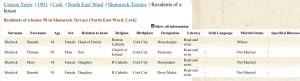
Thomas Sherlock. Appointed 15.8.1871. Pensioned 13.3.01. Was involved in the Dan Murphy incident (see 1894)
1872
William H Borrowes 12.1.72. 34 years Store Keeper. Salary £40 per year, with apartments, rations, light, fuel and washing. Died 27.1.1909
Eileen May. Appointed 14.7.1872. 18 years. Promoted Charge Attendant November 1902/ Pensioned April 1904.Pensioned 18.3.1895.
Julia Gregg. Appointed 16.1.1872. 26 years.
1873
What was happening ….
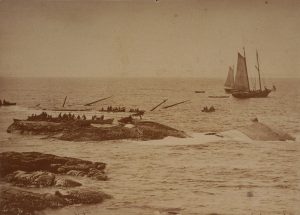
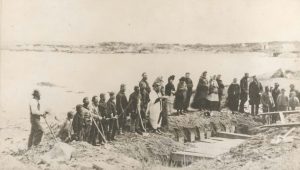
On March 21st, the White Star Line steamship “SS Atlantic”, sailing from Liverpool to New York, pulled into Queenstown (Cobh) where 161 passengers embarked. Ten days later, running low on coal, she diverted to the port of Halifax in Nova Scotia. Being unfamiliar with the approach to the harbour, the vessel struck rocks and sank. Over 560 people were lost including all women and children on board. Of the Irish passengers, 86 were drowned, including Mary Ryan and her nine children.
Appointment of new Resident Medical Superintendent
Dr James A Eames was appointed RMS in 1873 following the death of Dr. Thomas Power. He had served in the army as Assistant Surgeon during the Crimean War. At the end of the war he returned to Ireland and served as a dispensary doctor in Donegal before being appointed to the newly erected Asylum in Letterkenny.
He had studied in the Meath Hospital, Dublin and Royal College of Surgeons. His appointment to Cork was, according to his obituary, due “mainly through the influence of the Duke of Cambridge, whom he attended in the Crimea. He was president of the Medico- Psychological Association and a lecturer at Queen’s College (UCC). He died in 1886 from anthrax of the neck.
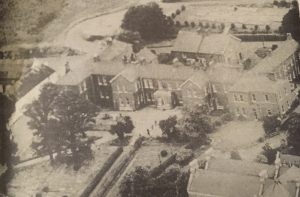
St Dympna’s Unit; opened in 1874 as an Infirmary 1874
Appointment of a new RMS on the death of Dr Thomas Power. Dr James A Eames had been an assistant surgeon during the Crimean War, and having left the army, was a dispensary doctor in Letterkenny. He was then appointed to the staff of the new Letterkenny Asylum.
John Jordan; Appointed 16.4.1873. John married Ellen Goggin of Blarney Street on 22 May 1877. Her father, Edward, was a Labourer. John’s father – Michael, deceased, was also a labourer. The wedding took place in North cathedral and was witnessed by John Cogan and Hannah O’Regan.
Mary Sexton Appointed 17.3.1873. Resigned 2.10.83
Sarah Haman. Appointed 8.8.1873. 18 years. Died 1.4.1895.
1874

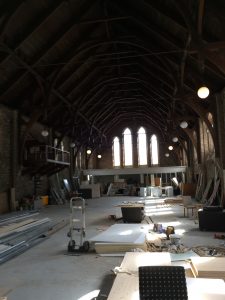
Kitchen Ballroom
“… in 1874 a refractory at the back of the building had been erected and utilised as a work room and recreation hall. The new hall was approximately 130 feet in length and 30 feet wide, fitted with a pitch pine floor, smooth and clean as wax deal and covered with a high arched open roof with timber dark and stained. the hall was connected to the kitchen (left above) at the western side, where through a large aperture food could be placed onto a mobile trolley and wheeled to serve the many long tables in the hall. at the northern side a store of tables was provided while at the eastern end a small hall connected by a door was allocated as the attendants dining area. this was intended as a mess where the attendants could dine together. At the northern side was also a band gallery some feet from the ground approached by stairs from an anteroom. artificial lighting was provided by means of 6 gasaliers each consisting of 8 lights but the hall too had adequate natural light provided by windows on either side with a very large window on the eastern side. the kitchen too had been extensively renovated with new steam apparatus installed for cooking..” from Hannah Henry’s Book Our Lady’s Psychiatric Hospital Cork. pp 141
Pay scales in 1874
Dr Alex Eames – RMS £500
Dr Ringrose Atkins, Assistant RMS – £110
Frances Hall – Matron – £ 75
George Crofts – Land steward – £50
Head Attendants (male) – £25
Head attendant (female) – £18
Attendants (male) – £14
Attendants (female) £8
Gatekeeper – £35
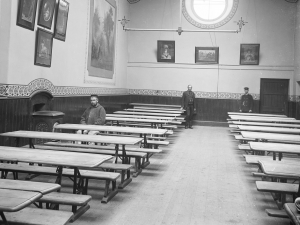
Ringrose Atkins was a doctor at the asylum at this time – we can see his name in the pay scale. He was later appointed RMS of Waterford Asylum. He is seen here in the dining room at Waterford
Denis Harty; Fireman & Attendant; Appointed 7.4.1874
1875
What was Happening…..
The Nation newspaper, April 24th 1875 reports
..This morning, at eight o’clock, William Tobin, Alias Rivers was executed within the county jail (where UCC stands now). for the murder of Johanna Cotter at Rathcormack in August last. The prisoner made no public confession of his guilt, but offered no denial of it since his conviction. Tobin was about 26 years of age. He was born in Killenaugh, near Tallow, his father being a small farmer. He left home some six years ago and nothing was known of him until he was convicted at Cork assizes of sheep stealing and sentenced to five years penal servitude. His conduct at Spike Island was of the most exemplary character and after four years he was discharged on a ticket-of-leave. he was entitled to a sum of £5 on leaving prison and with this sum he emigrated. He did not remain long in America and returned to this country after an absence of a few months. It is not known how he spent his time after his return, and in fact, nothing is heard of him until the tragedy at Rathcormack. The execution was performed by an American sailor who is undergoing a term of imprisonment in Cork Jail/
1876
John Doyle Carpenter & Attendant. Appointed 6.3.1876. Died 5.6.99
Michael Keating Upholsterer & Attendant. Appointed July 1876. Died 8.6.1917
Funeral of Cork Bandsman (1917)
The funeral of Mr Michael Keating, for more than a quarter of a century, a member of the No. 1 Barrack Street Prize Band, took place yesterday from the Cork District Lunatic Asylum, where for 41 years he had been employed as an upholsterer. His remains were followed to his last resting place at Douglas Cemetery by all his colleagues at the institution who could be spared from their duties and by many Nationalist citizens, with whom the late Mr. Keating was from his early days identified. , while the band of which he was so long a valued member attended and played funeral marches en route from the Lee Road to his grave.
The chief mourners were – Mrs Keating (wife), Michael and Daniel Keating (sons), Mrs Vickers and Mrs Heffernan (daughters). The following members of staff were present; Dr. James Cashman (assistant Resident Medical Superintendant), Dr F McCarthy, Mr Thos Reynolds (House Stewart), Thos. C Murphy (Clerk), Michael Devlin (bandmaster), J Fitzgerald (Clerk of Works), John Barry (Assistant Storekeeper). Mrs Tolerton (Matron), Miss Barry (Assistant Matron), Miss O’Brien (Head Attendant), Mr P O’Sullivan (Head Attendant), John Lane, Patrick Murphy, John Holly, Michael Rogers, D Leahy, D Hegarty, P Dwyer, Michael Riordan, J Riordan, D Spriggs, D Bradley, V Murphy, J Gould, D Mahony, H Ryan, D Kelleher, J Murphy, J Crowley, J Lynch, T Foley, John Murphy (Head Night Attendant, T Tynan, R O’Brien, T Donoghue, D Browne, D Sullivan, J Regan, J Ryan, W McCarthy. Amongst the general public who attended were Messrs, J Daly TC, D Gamble TC, P Cotter, Wm Meade, R Sisk, T Coleman, Mr Elliot (Female Prison). Rev F Flynn, Chaplain and Rev Fr Burts, cathedral, officiated at the graveside. [Irish Examiner June 11 1917, p2]
Mary Hill. Appointed 9.3.1876
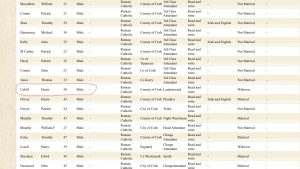
Denis Cahill, aged 25. Appointed 3.6.1876. Head Attendant and working (acting) Land Steward. Promoted Land Steward 20.7.86. Died 12.1.07
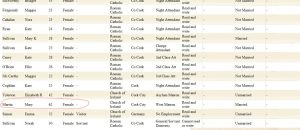
Mary Martin. Appointed 4.2.1876. Assistant Matron. Pensioned 8.12.1903
Drum Major S Wilkinson of the 89th Regiment appointed as bandmaster – he left the following year.
1877
Myles Dwyer Shoemaker; Appointed 12.10.1877
Michael Sweeney Head Attendant. Appointed 11.6.1877
John Trollope; Appointed 9.7.1877
John Cowhig Head Attendant. Appointed 5.7.1877
Timothy Healy; appointed 5.3.1877
Maurice Archdeacon 2nd Class Attendant. Appointed 13.6.1877. Census 01. 54 years 2nd Class Attendant. Pension 18.8.1908
Henry Rounce: Appointed 9.10.1877
Timothy Foley 23 years. Night Attendant. Appointed 5.3.1877. Promoted Charge Attendant 17.4.91. On 4th April a patient attempted suicide by jumping into the River Lee while out walking. Charge Attendant Foley assisted by jumping in with his clothes on.
A McHugh appointed bandmaster, he left in 1880
1878
British Medical Journal. August 10 1878
Cork District Lunatic Asylum
At the monthly meeting of the governors of the Cork District Lunatic Asylum, held last Saturday, the recent appointment of Dr Lombard Tanner s Assistant Superintendent of the asylum was confirmed by the board
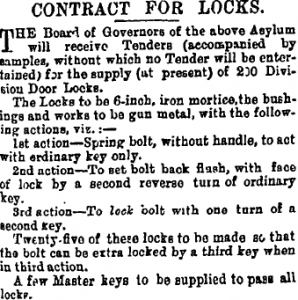
We are beginning to see the everyday workings of the Asylum. Here is an advertisement for locks with which every attendant from 1878 right down to our own day in the 1980s will be familiar
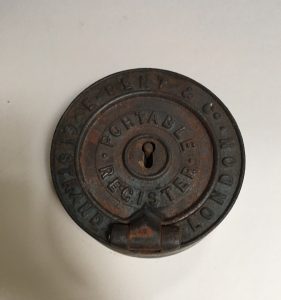 This is a terminal for the ‘checking system’. These were placed at strategic points throughout the wards. The night staff were required to turn their key in this lock every hour to leave a record that they had indeed carried out their ’round’.
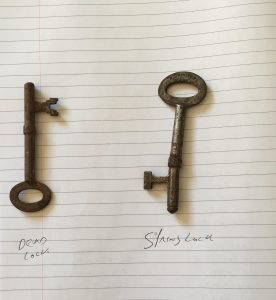
Keys used in the Hospital in the 1980s
1879
Teresa Mitchell; appointed 1.8.1879. Appointed 1.8.1879
Mgt Lynch Assistant Laundress. Appointed 24.2.1879
Mgt Trollope; Appointed 10.12.1879
Rev WH Powell. Appointed 1.1.79. Protestant Chaplain. Died 12 August 1912.
1880
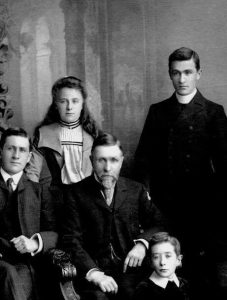
Edmund O’Flynn of E & P O’Flynn, who won the contract to connect the three original blocks of the Grey Building together. Worked commenced in 1877 and was complete in August 1880.