The Early Years
The earliest report about the condition of the lunatic poor in Ireland dates to the Report of the Select Committee of 1817. Between the 25th of June of that year and 2nd of July the commissioners held interviews with the administrators of the existing asylums or more correctly the places where the lunatic poor were being accommodated. Until this time there were just two asylums in the country. The Richmond Asylum (Grangegorman) had opened in 1815 and received 150 lunatic poor from the House of Industry [p3]. Needless to say, the commission found the amount of accommodation was “totally inadequate for the reception of the Lunatic Poor” [p3]. The only other place take received large numbers of poor was the Asylum in Cork which had opened its doors in 1792.
A committee member, George Fitzgerald Hill, reported that there was accommodation for 12 patients in Derry attached to the Infirmary. He found that the building was “sufficient for the mere custody” of lunatics and then went on to describe the structure as “mere sheds attached to the inner wall of the infirmary”[p7].
In Wexford, things were not much better. The old Jail had been acquired in 1816 and was now used to accommodate lunatics. No further information is given.
John Leslie Foster appeared before the committee to tell them of his piece de resistance – the newly opened Richmond asylum of which he was a governor. He told the committee that they had received their first 200 patients from the nearby House of Industry. There were many more applicants than there was room to accommodate so they decided that they should only admit patients who had some chance of being cured. The Richmond would not be a place of custody. Their work at the Richmond had an unexpected side effect.
The Richmond Asylum; latterly St Brendan’s Grangegorman
The new policies operating at the Richmond were taken up by the House of Industry and both establishments and their occupants greatly benefitted from the reformed system. Gone were the days when “two lunatics shared a bed in the House of Industry” [p9]. The overcrowding that Foster had seen with his own eyes in the old House “fifty to sixty persons in one room, the majority of them insane, the rest mere paupers”. The overcrowding was so bad that he saw “ a lunatic chained to the bed, the other half of which was occupied by a sane pauper” [p9] “and the room so occupied with beds that there was scarcely room to move in it” [p9].
 But what was this new regime that was working so well in the Richmond? Not only could Foster explain it to the committee – he was delighted to do so. The old ways of coercion were gone. Had not the great Parisian physician, Pinel, “proposed and published a more gentle mode of treatment” [p10]. Nor was Pinel alone in so proposing. In England, Tuke, the manager of York Asylum found the exact same thing. And if it worked in Paris and it worked in York, there was no reason why it would not work in Dublin. Indeed, with a brand new Asylum like the Richmond, things could work out even better. “There is not in the Richmond Lunatic Asylum, to the best of my belief, a chain, fetter or handcuff and there is not one patient out of twenty confined to their cell”. [p9]. Warming to his subject Foster went on “the disorder (lunacy) is not treated so much as subject of medical care as of the superintendence of a person, who is termed a moral governor, and whose particular business is to attend to the comfort of eh patients, to remove from them causes of irritation, to regulate the degrees of restraint and provide occupation for the convalescent” [p11].
This was heady stuff and a long way from the days when patients spent their days in dreary cells in chains. A new era had dawned and the mentally ill could look forward to a time where their interests were placed at the very centre of the asylum – everyone could look forward to that? But if the future was bright for Dublin, things were not quite so rosy in other parts of the country.
Thomas Spring Rice
Thomas Spring Rice, MP and life governor of the Limerick House of Industry, was examined by the committee. He told them that he had visited the asylums in Cork, Tipperary, Limerick and Waterford. In Cork, he noticed that as far back as 1800 there were a mere seventy two lunatics in the asylum. Astonishingly, this year the number had grown to 219 [p11]. While heredity and “increased use of spiritous liquors” can partially account for this “accumulation”, it seemed to Rice that Cork was a victim of its own success. “The establishment at Cork has gained so high a reputation, that there are now a vast number of individuals sent to it from districts wholly unconnected with the city or county” [p11]. Rice’s was in danger of losing the run of himself. Obviously, Cork naturally, was better than Dublin “it is the best managed, not only that I have ever seen but ever considered or heard of” [p11]. It was even in danger of rivalling Tuke’s Asylum at York.
And to what did he attribute this level of success. Well, money of course. The people of Cork were happy to contribute to the building and running of the establishment – even if the government wasn’t. But “human ingenuity and skill” played a part. The physician “who was at the head of it” was a great man. If they could get things so right at Cork without any money from central government, imagine how things could be if they didn’t have to rely solely on the generosity of the Cork citizenry. Indeed, that was the very reason why Rice was now giving evidence to the committee. He wished to use the platform provided by his appearance to advance the case that Cork should be included, as Dublin was, in the allocation of Government funding.
But Rice had other things to say. He had visited Waterford and found that the establishment there “consists of a few miserable cells attached to the house of industry, resembling an ill-constructed goal rather than a retreat for lunatics” [p12]. However, one thing about Waterford stood out. Their system of management seems very good. The committee there met once a month and appointed from their number a smaller committee which met once a week. This committee, appointed from their number a still smaller committee which visited the cells once a day “this produces a system of constant inspection and control, without which, it is but vain to expect the prosperity of any establishment” [p13]. Indeed, the Waterford system was so efficient that the Tipperary men in charge of the Clonmel asylum had copied it. But try as they might, they were no match for the indominable Deice. When Rice visited Clonmel in 1814 he found 32 lunatics there. But management so little understood the treatment of insanity that they were “unable even to keep them clothed and some were lying in the yard upon straw in a state of nakedness” [p14].
While he though they were making at least some efforts in Clonmel, Rice was despondent when he spoke about Limerick. Even though the number of lunatics had increased from a mere fourteen in 1804 to an alarming forty- eight in 1814, he thought that there were very few admissions in the last five years. Things had become so bad at Limerick and its reputation so low that the lunatics refused to go there. The accommodation there is “such that we should not appropriate it for our dog kennels” [p14]. “It consists of one open arcade behind which cells have been constructed, with stone floors, without any mode of heating and exposed during the whole of the winter to the extremities of the weather. I am informed by the physician who attends that the death of two patients was to be exclusively attributed to the coldness of the situation” [p14]. Thirty- three people occupy thirteen cells “some of them in a state of furious insanity. In order to protect them from the obvious results, the usual mode of restraint was by passing their hands under their knees, fastening bolts around their ankles and passing a chain over all and then fastening them to a bed. They have lost the use of their legs” [p15]. If the committee thought that things were bad in the cells, they were shocked when Rice explained what he found in the infirmary. “In one room I found four and twenty individuals lying, some old, some infirm, one or two dying, some insane and in the centre of the room was a corpse who had died a few hours before. In the adjoining room I found a woman with the corpse of her child left upon her knees for two days – it was almost in a state of putridity” [p15]. And among this horror strode the “keeper of lunatics who claimed an exclusive dominion over the females confined to his charge, and which he exercised in a most abominable manner. I decline going into the instances, the character of which are the most atrocious” [p15].
The next witness called was the Right Hon. Denis Browne. He pointed to the difficulties arising from trying to provide for the lunatics in such an isolated area as County Mayo. He had long argued with his wealthy Connaught neighbours about the necessity of providing an asylum but their incessant and effective objections saw his abandon his efforts of public funding. He built a small asylum from his own money and hired a woman from Dublin to manage it. She – Ms Dogherty – was so successful that within two years she had come to the attention of the Dublin providers and was head hunted into the Richmond where she became the manager. This was a remarkable feat in 1817. Undaunted, Browne continued his efforts to provide for the lunatic poor. Often, he would find that a case would present with such complexity that he had no means of providing care. In these instances, he sent the unfortunate person to Dublin. He did this as a last resort because the treatment of the patient on the journey was brutal. William Saunders of the Cork Asylum had written to the committee about the hardship involved in transporting lunatics on long journeys. He said that their handlers would often ply their passengers with drink to subdue them, so much so that sometimes it was impossible for the receiving doctor to determine if the symptoms were caused by “mania or inebriation”. If drink didn’t work, the carriers thought little of tying their charges up. Sometimes so tightly that their wounds would be permanent. If neither strategy had the desired effect, their companions would revert to brute force and the physician could not tell “between a mere surgical patient or the victim of some punishment” [ p18].
But on reaching Dublin their travails were not at an end. Indeed, Browne was at a loss to know what had become of his charges on whom he had spent two guineas a piece to secure their passage. When he visited Dublin to check on their welfare he was surprised to find that “upon examining the place in Dublin where we had sent those lunatics, on enquiring for them by name, I could find but one woman in the House of Industry out of thirty or forty that we had sent up” [p22].
To confirm the excellent character of the Richmond, Browne was delighted to find that two of his lunatics were in the establishment – one was cured, the other, however, “is uncurable”[p22].
With the varying degree of care or the lack of it, offered by the establishments – good in Richmond, excellent in Cork, fair in Waterford, poor in Clonmel and disgraceful in Limerick, there was a further dimension and implication for lunatic who could not access the asylums. Brown offers an unsettling view into the care of the lunatic at home
“There is nothing so shocking as madness in the cabin of the peasant, where the man is out labouring in the fields for his bread and the care of the woman of eh house is scarcely sufficient for the attendance on the children. When a strong young man or woman gets the complaint the only way they have to manage is by making a hole in the floor of the cabin, not high enough for the person to stand up in, with a crib over it to prevent his getting up, the hole is about five feet deep, and they give this wretched being his food there, and there he generally dies. Of all human calamity I know of none equal to this, in the country parts of Ireland which I am acquainted” [p22].
The commission completed its work in July 1817 with the recommendation that a series of District Lunatic Asylums should be constructed around the country to provide for the insane poor. Within 40 years – 1857 – there would be 16 District Asylums and a Central Criminal in Dublin. The mentally ill would now begin to leave the Houses of Industry and the Work houses but the great plans of the pioneering physicians like Pinel and Tuke would be sacrificed on the alter of financial expediency and the great promise of these early thinkers would soon be overtaken by what Faucault called “the great confinement” .
In the eighteenth century we can see the emergence of private or charitable institutions like those founded in Norwich (1713), Newcastle (1764) and Manchester (1766). In Ireland we can see this trend continuing in the founding of St Patrick’s Hospital in Dublin in 1774, following an endowment left by Dean Swift. Despite the best efforts of the founders, the number of places available for pauper lunatics was miniscule and the majority of those suffering from mental illness remained in the care of their families. The Cork Asylum, attached to the House of Industry opened its doors to receive lunatics in 1791, while we have seen that many of the Houses of Industry contained some facilities for the maintenance of lunatics. However, the conditions in most institutions were overcrowded and inhumane – as we have seen in Waterford, Clonmel and especially Limerick.
Treatment of mental illness in the institutions by 1800 was archaic. Jones [1972 p7] points out that the standard treatment recommended various herbal purgatives and bloodletting to help balance the four humours which were thought necessary for the maintenance of good health. Blistering of the skin with hot irons or caustic agents was a common treatment, while boring holes in the suffers head to release excess humours was also thought to be effective. Even the king, George III was not immune to the harshness of the times. When he developed a serious mental illness, he, too, was subjected to a course of purging and bleeding. If the treatments did little good for the Royal mind, it did help to “lend a certain aristocratic gloss to mental illness and to bring the physicians (called ‘alienists’ at the time) into the spotlight more than had been the case” [Kosky, Eshkevari and Carr 1991 p3 and Levine 1891 p14]
If the king himself was not spared the worst of the treatments we can imagine how bad things might have been for the pauper. Scull (1993) shows that conditions in at least some of the asylums, while forming the basis of many fictional narratives, were in fact appallingly real. We do not have to travel to Bedlam Asylum in south London to find evidence of abuse (both sexual and physical), cruelty and misappropriation of funds. We can find plenty of abuse at Limerick and other Irish institutions as we will see in the pages that follow. At the York Asylum, an investigation in 1814, provided evidence of wrong doing on a massive scale. It is hard to think how an asylum like the York, first built with a humanitarian concern for the welfare of the mentally ill, went from being commended for its excellent management and promoted as a model for others to imitate [Digby A; Changes in the Asylum, the case for York 1777 – 1815 Economic History Review, New Series Vol 36, No 2 (May 1983) p220], to one which 30 years later was the cause of national outrage. As early as 1788, suspicions were being raised about the secretive way that the asylum was being run. However, it would take another twenty years for something to be done about it. In 1809, William Tuke openly voiced concerns about the place but it would be another four years before his grandson exposed the extent of the abuse that was taking place behind the walls of the Asylum. Claims of cruelty, whippings and rape were first denied by the Asylum management. But in the face of overwhelming evidence that the accommodation was overcrowded, damp, gloomy and ill-ventilated, the food was wretched and lack of attention meant that the patients were filthy, it could no longer be denied. Worse was to come. An unexpected visit to the asylum discovered the existence of four hidden cells. Thirteen old women had spent the night in a space “only eight feet square and inches deep in excremental filth”. It transpired that the physician in charge and his predecessor had been misappropriating money for their own uses and the food served to the patients, poor by any standard, was hardly capable of keeping body and soul together. Attempts continued to be made to cover up the extent of the abuse. A fire destroyed a portion of the building in December 1813 and records were so badly maintained that nobody could be sure how many patients died in the blaze. Where the asylum had been designed for the care of 54 patients, by July 1813, it housed 199 [Digby p232]. They were looked after by seven “keepers”. It was finally admitted that the abuse was financial as well as physical when “Mr. Surr, the doddering octogenarian, who held office (of steward responsible for keeping the accounts)” inadvertently sent two sets of accounts to the committee investigating the place. The game was up. Management were sacked but the physician with overall responsibility for the running of the asylum was allowed to resign.
William Tuke
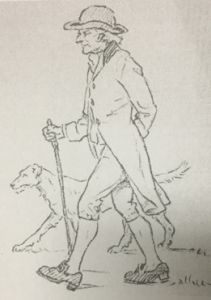 That such abuse could occur in the same city – literally a mile away from where the enlightened Tuke had opened his “Retreat”, shows that the history of treatment of the mentally ill did not always travel in a straight line. Tuke’s concern for the abuses taking place in his local asylum was informed by his staunch Quaker beliefs. His belief that “madness could be remedied not only by kindness but also with a proper atmosphere and environment” [Edginton; the York Retreat p9] led him to persuade the York Society of Friends to fund such an institution where he could put this theory into practice. In 1791, they opened the York Retreat.
Instead of the familiar grim structures which housed the insane, Tuke’s building would emphasise the quality of the environment. “An important object is the keeping of the interior of the hospital cheerful and comfortable which is calculated to produce a beneficial affect upon the inmates”. Even the name he chose seemed to break with tradition – no longer would the place be called an ‘asylum, at York it would be a ‘Retreat’. Carpets, wallpaper and ‘lively paintings’ remedied the gloom. Large windows and skylights allowed more sunlight in, creating “an agreeable prospect and great quantity of light and air”. In the bedrooms – where previously the walls were whitewashed or coloured, they are now painted or papered. Several of the galleries have been newly painted, their walls decorated with additional paintings and their ceilings relieved by hanging plants and bird cages”. Not alone would the interior be agreeable. Tuke insisted that the grounds too would be agreeable.
Tuke’s York Retreat
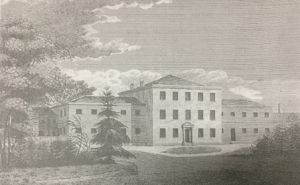 Spaces for recreation were designed – for tho their minds are disordered many of them [patients] have vigorous bodies that require exercise to preserve them so, otherwise disorders may be generated by their confinement that might prove more fatal and dangerous than what they were put in for” [Edington 9114]. “The Retreat was to be built as a middle-class family home with acres for keeping cows, a vegetable and flower garden, exercise grounds for recreation workrooms and a view of the surrounding countryside”; [The design of Moral architecture at the York Retreat; [Edginton Barry Journal of Design History Vol 16 No 2 (2003) pp103 – 117)]; above all “the design paid attention to the feelings of the patients” – something that those who were familiar with conditions at Limerick, twenty years later, would have found astonishing.
Nor was he alone in his efforts to reform the system. The reformers did not have far to look to see that things could hardly be much worse. In Paris, a young physician, Phillipe Pinel, working at the Bicetre Hospital with two hundred mentally ill men, was developing an approach to the treatment of mental illness based on the principals of non-violent, non-medical management.
By 1795, he was chief physician at the Hospice de Salpetiere where he published his philosophy on the treatment of mental illness. Here the legend arose that he single-handedly removed the chains and fetters from the patients. No more purging, bleeding and blistering, from now on all interventions would involve close contact with patients. They would be treated with kindness and humanity – care would be taken for their comfort.
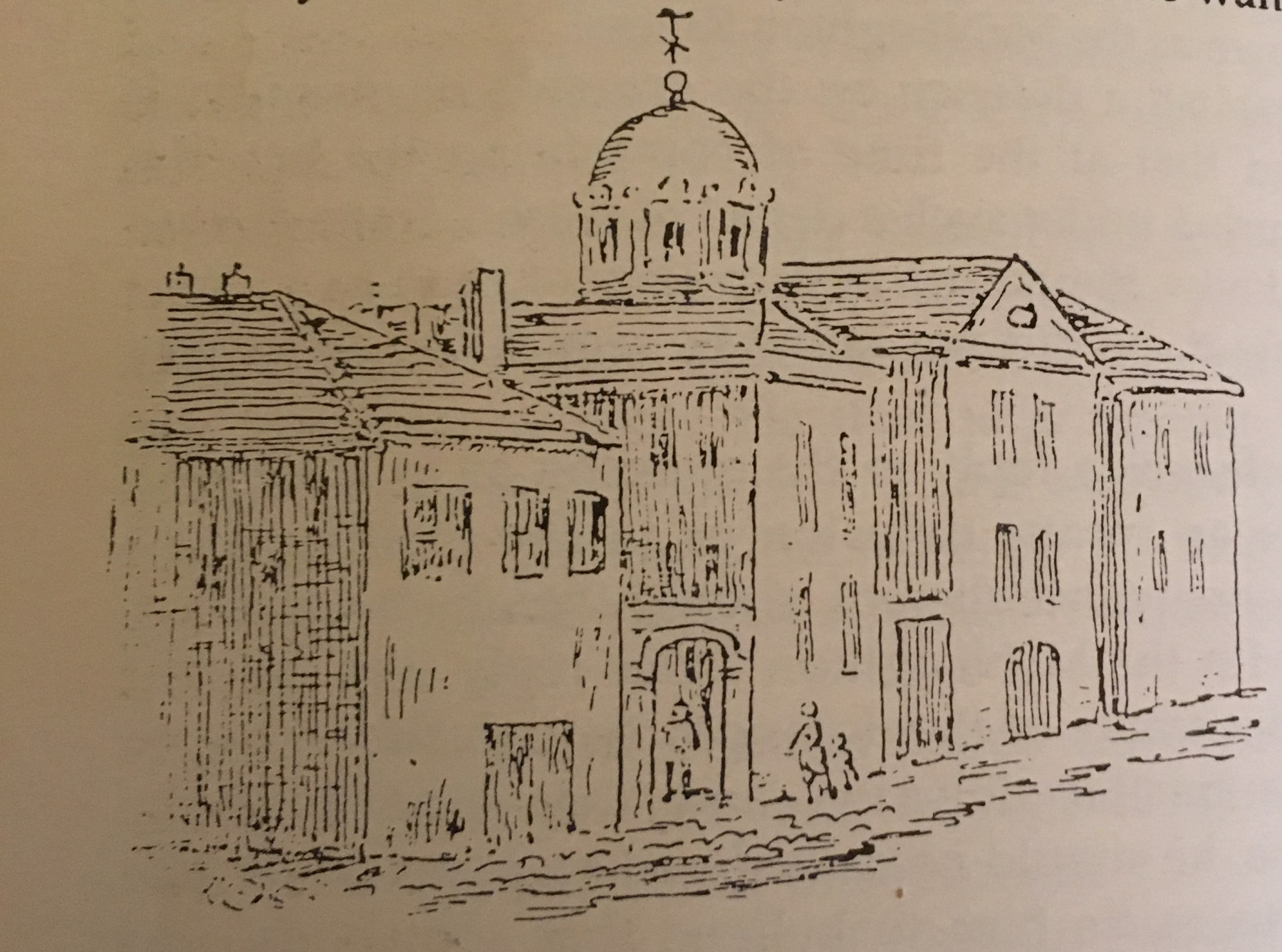
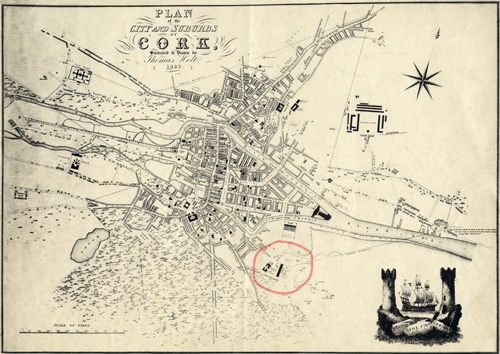
When Tuke was opening his Retreat in York, the Lord Mayor of Cork, Richard Harris was having similar ideas. A concert was held in Cork to raise funds to build an Asylum. A site was found on the Blackrock Road, about a mile outside the City boundary. It was located on adjacent to what is now the South Infirmary / Victoria Hospital Complex. It consisted of 200 cells for patients, a few day rooms and a few dormitories. Outside was a ball court and exercise yard, all located on about 4 acres of land.
Staff working in the Old Asylum
Thomas Osbourne Physician Henry Hardy Secretary Henry Smith Moral Keeper
Richard Thorpe Store Keeper Mary Merrick Matron Patrick Gynan & Wife Keeper
Thomas Whelan & Wife Keeper John Coleman & Wife Keeper Edmund Brown Keeper
Thomas Homan Keeper Daniel Murray Keeper Ellen Flannery Keeper
Susan Hewitt Keeper Mary A Donovan Keeper Alacia Browne Keeper
Mary Armstrong Hospital Nurse Margaret Harris Nurse Catherine Burns Nurse
Hanorah Brown Nurse Hannah Riordan Nurse Mary Punch Nurse
Mary Flynn Nurse Ellen Shea Nurse Ann Hughes Nurse
Margaret Lowther Nurse William Hurley Super-intendant of Engine John Crowley Cook
Ellen Grainger Cook Eliza Grainger Cook Nicholas Beamish Gate Keeper
Maria Gordan Gate Keeper John Roan Porter Denis Browne Watchman
John Buckley Barber John Rearden Shoemaker William Galvin Whitewasher
Margaret Murphy Laundress Ann Hodder Laundry Assistant Mary Callaghan Laundry Assistant
Francis Doyle Laundry Assistant Johanna Sheehan Laundry Assistant Thomas Flanagan Scavenger
John Coleman Scavenger Patrick Duggan Scavenger Johanna Corbett Scavenger
Ellen Murphy Scavenger Jonathan Flynn Messenger Michael Walsh Messenger
Mary Hennessey Matron’s Servant Jeremiah Hogan Pensioner Julia Callaghan Pensioner
Mary Downey Pensioner
A Shocking Murder
Perhaps the most (in)famous patient in the Old Asylum was Captain Stewart of the ‘Mary Russell’. The Mary Russell was a brig that sailed from Barbados to Cork carrying a cargo of sugar. When it arrived in Cork on 28th June 1828, inspectors were horrified to find that seven of the crew had been murdered. They had been tied up and bludgeoned to death with an iron bar. There was no sign of the captain.
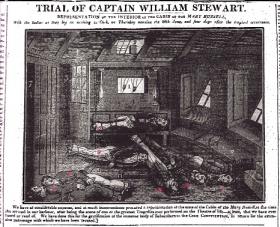
A few days later, Captain William Stewart was handed over to the authorities in Cork. He had jumped overboard off the coast of Castletownbere and was rescued. Now the full horror of the story was told – see www.historyireland.com/18th-19th-century-history/forced-from-this-world-massacre-on-the-mary-russell… He was found to be insane and was committed to Dundrum Criminal Asylum. But Dr Osbourne, of the Cork Asylum, had impressed the judge during the trial, now managed to have Stewart transferred to Cork. Tradition records that he remained in the old Asylum until it closed in 1852 and was then transferred to the new place on the Lee Road. Steward liked Dr Osbourne and he made, it is said, a scaled model of his ship as a gift to the doctor. We are told that it was made out of bones! Things were going well for the Captain, until Osbourne retired. The captain had a relapse and killed one of our colleagues. he was dispatched back to Dundrum where he died in 1873. While the story is exciting, there is however no evidence that he ever set foot inside the new Asylum. In fact, we are told that he was transferred to Dundrum n 1851. Intriguingly though, I have discovered a photograph of a model ship among the records of OLH – could this be a photo of the ship created by the murderous captain?
Introduction
In 1847 the new asylum on the Lee Road was under construction and would be ready to open in 1852. The old place on the Blackrock Road was about to be abandoned because it was beyond redemption.
In July 1847, Dr John Conolly of ————-Asylum delivered an address to the assembled Superintendents of many of the asylums in England, Scotland, Wales and Ireland. It was an important paper as far as it goes as it outlines, perhaps for the first time, a general philosophy for the care of the mentally ill – or in the language of the day – of the insane. In this great era of Asylum building, he talks about the importance of the setting of the asylum. “Patients” he said “of all classes derive advantage from the circumstances of situation. If it is intended to receive patients of the educated classes, it should be situated amidst scenery calculated to give pleasure to such persons when of sane mind”.
Site of the old Asylum – now the South Infirmary
The Old Asylum.
Staff by year of Appointment.
1836
It is difficult to know who the staff of the earliest Cork Asylum were. The Freeman’s Journal of July 6th 1836 tells us that Mr Smith, for some years the Moral Governor of the Cork Lunatic Asylum has resigned and taken up the same in Waterford
Samuel Hobart. Surgeon. Appointed to the Old Asylum 4.6.1816. Hobart was originally the apothecary (pharmacist) at the old Asylum on the Blackrock Road and was subsequently appointed surgeon [1858 Report of Select Committee p457]. He visited the Lee Road Asylum two or three times a week to carry our surgical procedures as required.
1838
________________________________________
1839
Hannah Brown. Assistant Nurse; Appointed 1.8.1839
________________________________________
1840
William Connell. Clerk; Appointed 15.7.1840. Connell moved to the new Asylum in 1852.
Thomas Whelan. Attendant; Appointed 24.4.1840. Thomas and his wife were Keepers in the Old Asylum and were paid £22 per year. He moved to the new Asylum in 1852.
________________________________________
1841
________________________________________
1842
________________________________________
1843
Extracts from Report of Inspector of Lunatics 1843
County and City of Cork Lunatic Asylum
On the day of my inspection, the 17th September, 1843, the number confined in this institution was 439 patients…. a number far exceeding any lunatic asylum in Ireland. This overgrown asylum is necessarily defective in all particulars, except the efficiency of the officers, to whose credit it is to be stated, that much order prevails.
The whole buildings, yards, garden, and exercise ground, stand on about four acres. The site is on rising ground, but fifteen more acres should be obtained in the immediate vicinity…… it would be preferable if removed a little farther from the city; and it may be questionable whether it would not be better to choose an entire new site.
This establishment was at first a house of industry, and continued so till the poor-house was occupied.
I found the entire establishment remarkably clean, and the health of the inmates carefully attended…..
James Palmer, Inspector- General.
………….”They [the keepers] were an inferior class, unable to give any information about patients and thought that the Keeper in Charge was a Lunatic himself…”
Report of Inspector of Asylums 1843
Staff Appointed;
1843
William Rennick. Steward; Appointed 2.7.1843
Nicholas Beamish. Storekeeper; Appointed 1.4.1843. When he moved to the new Asylum in 1852, he is listed as being the Gatekeeper.
________________________________________
1844
Rev Charles Clifford. Protestant Chaplain; Appointed 24.8.1845
________________________________________
1845
The Cork Examiner reports on that the Cork Asylum has been incorporated into the District Lunatic Asylum system and is now known as the Cork District Lunatic Asylum [3rd September 1845 p 2]
Thomas Power MD; Appointed 1.8.1845.
Power is an interesting character. He was the Doctor in charge of the old asylum and moved to the new asylum in 1852. He described himself as Resident Physician (Freeman’s Journal 20 June 1857) and visiting physician to the new asylum. He said that there is also a ‘visiting surgeon’ attached to the Asylum (Samuel Hobart) with whom he has no arrangement. See more about Dr Power in 1853.
Mary Merrick. Matron .…”The Matron has been a long time at the head of this department, and though a very estimable and humane person, yet I regret to add, she is not equal to fill so arduous an office without an assistant..” [Inspector of Asylums 1845]
William Jones. Apothcary; Appointed 4.12.1845
Rev P Burton. Catholic Chaplain; Appointed 20.9.1845
Jeremiah Collins. Attendant
William Sullivan. Assistant Attendant: Appointed 1.7.1845; Resigned 1.11.57
Eliza Phair. Division D: Appointed 1.1.1845; Resigned 13.3.57
Ellen O’Keeffe. Division D; Appointed 14.8.1845
Catherine Dooley. Appointed 10.10.1845.
Timothy Sullivan. Assistant Attendant. Appointed 1.7.1845; Retired 1857
Staff of Asylum 1843
Name
Thomas Osburne Physician
Henry Hardy Secretary
Henry Smith Moral Governor
Richard Thorpe Store Keeper
Mary Merrick Matron
Patrick Guynan & Wife Keepers
Thomas Whelan & Wife Keepers
John Coleman & Wife Keepers
Edmund Brown Keeper
Thomas Homan Keeper
Daniel Murray Keeper
Ellen Flannery Keeper
Susan Hewitt Keeper
Mary A Donovan Keeper
Alicia Barrett Keeper
Mary Armstrong Hospital Nurse
Margaret Harris Nurse
Catherine Burnes Nurse
Hanora Browne Nurse
Hanna Riordan Nurse
Mary Punch Nurse
Mary Flynn Nurse
Ellen Shea Nurse
Ann Hughes Nurse
Margaret Lowther Nurse
William Hurley Super of Engine
John Crowley Cook
Ellen Grainger Cook
Eliza Grainger Cook
Nicholas Beamish Gatekeeper
Maria Gordan Gatekeeper
John Ronan Porter
Denis Browne Watchman
John Buckley Barber
John Rearden Shoemaker
William Galvin Whitewasher
Margaret Murphy Super of Laundry
Anne Hodder Laundry Assistant
Mary Callaghan Laundry Assistant
Frances Doyle Laundry Assistant
Johanna Sheehan Laundry Assistant
Thomas Flanaghan Scavengar
John Coleman Scavanger
Patrick Duggan Scavanger
Johanna Corbet Scavanger
Ellen Murphy Scavanger
Jonathan Flynn Messenger
Michael Walsh Messenger
Mary Hennessey Matron’s Servant
Jeremiah Horgan Pensioner
Julia Callaghan Pensioner
Mary Downey Pensioner
Nobody can tell for sure what had happened but the later inquiry revealed that Stewart – normally kind and gentle – had become convinced that his crew were about to mutiny. He had gone mad. Enticing crew members to his cabin one at a time he managed to tie them up. As his delusion became increasingly florid and in an attempt to extract confessions, he beat all seven crewmen to death. When the ship was passing Castletownbere, she encountered the Mary Stubbs sailing from America to Belfast. The Mary Stubbs noticed the erratic course of the Mary Russell and sent a boarding party on. When they approached the ship they saw a man jump into the sea but could not rescue him. They were the first to find the murdered men. A day after the Mary Russell tied up in Cobh, Captain Steward arrived in Cork under police escort – it was he who had jumped overboard but was somehow rescued and now returned to Cork to meet his judgement. At his trial, Dr Osbourne of the Cork Lunatic Asylum was called to give evidence as to the mental state of the captain. Clearly mad, he was spared the rope but sentenced to life in the Cork Asylum – a fate considered by many to be worse.
Once safely in the Asylum, the captain – now famous – exhibited the most dramatic symptoms and could only be calmed by Dr Osbourne himself. At last he settled into asylum life and occupied himself by making model ships. In a way that only the Asylum can narrate, the models were made out of chicken bones [remarkably there is a photo in the Cork Public Museum among the Our Lady’s Hospital archives of a model ship – it is sorely tempting to think that the reason this photo survived is because it is a representation of one of Captain Stewart’s models – alas made of wood not bone]. It is said that he killed one of his attendants in a fit of madness during his stay at the new Asylum on the Lee Road. There is no evidence at all to support this story and I think we have to attribute it to the folk-memory of the place. He was transferred to the Central Lunatic Asylum in 1852, so never set foot in the new asylum.
In 1855, we find the Inspector of Lunatics referring to Captain Stewart’s confinement in the Criminal Lunatic Asylum in Dundrum. “For twelve consecutive years this man had periodic attacks of violent madness, within the last four, however he has shown no symptom whatever of the disease; his time is principally devoted to pious reading, though never spoken to on the subject of his offence (according to an established rule in the Asylum) he has lately expressed his conviction that the crew actually mutinied with intent to murder him. This delusion, is thus, as fixed as ever and did a second opportunity present itself, the consequences dependent on him, might under similar circumstances, be alike unfortunate”. [Report of Inspector of Lunatics 1855 p 19]
He could not escape the notoriety of his case for even the Inspector of Lunatics couldn’t resist; “He is ever ready to lend assistance to the sick and weakly; very reticent on the cause of his confinement, he has referred to it but once for some years and then as an act of self defense – a delusion, which, judging from his uniform tranquility, he no doubt continues to entertain [Report of Inspector of Lunatics..]
By 1874 Captain Stewart is dead, “among the deceased is one to whose history we should revert; in the instance of Captain S….who died early in August, taking the date of his offence into account, he was the oldest criminal lunatic in the kingdom. He was transferred to Dundrum, on it opening from the Cork Asylum, of which he had been an inmate for nearly 22 years, having been acquitted so far back as 1829, on the grounds of insanity, of the murder of 7 men – the whole crew in fact, with the exception of two boys on a vessel then under his command and on its return from Bermuda. There never existed a doubt as to the complete irresponsibility of the unfortunate man. Possessing originally a very decided character but becoming the subject of a mental disease from continuous excitement and want of sleep for nearly a fortnight, he laboured under the delusions as to the intended mutiny amongst his shipmates. After inducing them, in proof of their subordination and of the absence of such intention to allow themselves to be tied down with ropes on deck, in which position they lay for nearly an hour, the first mate chowing the example, when approaching Cork Harbour, with an iron bar he deliberately murdered them in succession. After some time he recovered his reason in the District asylum. He was remarkable from a uniform kindness of disposition towards his fellow patients. His piety is also conspicuous being constantly engaged in reading the bible and religious works. Occasionally, however, he has violent relapses, proceeded by a taciturnity (shyness – dislike of gossip) unbroken for several days, save by quotations of an incoherent character or a repetition of nautical phrases. For a few years before his death his memory and mental powers perceptively declined. He died from senile decay over 80 years of age. His brain, small in size, was found to be perfectly healthy and the component parts in a normal portion. The only morbid indication noticeable was a slight opacity of the membrane covering the middle and posterior region of the organ, thus strongly indicating that grave mental affections can exist for a long series of years without appreciable legion of structure” [Report of Inspector of Lunatics 1874].
1846
Wages of Keepers, Nurses and Servants of District Lunatic Asylums 1846
Report of Inspector of Lunatics 1846
The numerous defects existing in this asylum have been pointed out in former reports, it is quite unnecessary to repeat the same history or to enter into any lengthened detail in the present report upon a subject so well known and now so universally admitted as to have led to the very important arrangement of ultimately abandoning the building altogether and the erecting of a new asylum which is in a delightful situation, close to the city, having all the advantages of good air, cheerful and beautiful scenery and at the same time well sheltered from the north east winds.
It is not relevant here to state that the present asylum was established so far back as 1792 for the reception of the insane poor of this county and city and it originated with the governors of the House of Industry and depended solely in its infancy on the exertions for its support, subsequently funds were permitted by parliament to be raised for the security and protection of the destitute insane in Ireland and the funds so raised for this purpose, as regards the county and city of Cork, were entrusted to the same body who continued to superintend the institution and who had already displayed so much benevolence and humane attention to the afflicted classes.
The extent and importance of this asylum made it at length desirable that it should not be connected to the House of Industry or any other establishment and accordingly the Grand Jury of the Spring Assizes of 1839 in compliance with an Act of the 6th and 7th of William IV transferred the care and management of the asylum to a board of superintendents consisting of members selected by the Grand Jury. This body continued to manage the affairs of the asylum until the passing of the Act of the 8th and 9th Victoria Chap 107, when according to its provisions, a board of governors was appointed upon who devolved the superintendence of this very important and extensive institution. The board met monthly to transact the routine business of the institution and a managing committee appointed from the body whose duty it is to examine in detail matters more immediate connected with the general economy and supervision of the establishment.
The asylum has been inspected on three several occasions during the past year. The last inspection took place on 30th November last year. The physician and manager accompanied me. The house appeared over crowded – the idiot and incurable ward being, in extent, disproportioned to the number of patients confined in them. As to classification, no proper system could adopted under so untoward circumstances. The female wards in the lower parts of the building appeared to be in a very bad condition. The patients were in a state of greatest excitement – nothing but confusion and irregularity prevailed. I examined the attendants particularly and found they were not sufficiently intelligent and active for the performance of such onerous and important duties. The matron has been a long time at the head of this department and although a very estimable and humane person, yet I regret to add, that she is not equal to so arduous an office without an assistant, who ought to possess the requisites which are indispensable in the fulfilment of such duties.
The male division seemed to be better managed and the classes were generally more tranquil and much more order and regularity was observed to prevail amongst them. The male attendants were superior in every respect to the female keepers but that is universally the case in all asylums and it is very difficult to precure properly qualified persons to fill these situations.
I found the infirmary department in very good order. It is remarkably clean and regular – it formed a detached building altogether from the asylum and is in every respect better circumstanced as to pure air and ventilation than the other parts of the building. There was not much sickness prevailing at the time, and generally speaking the house has been pretty healthy during the year. There were a few old cases labouring under chronic disease, confined to bed and 69 cases reported under special treatment of insanity. The number of deaths which occurred during the year was 32.
It appears that of the 61 recoveries which took place during the past year, four fifths were recent cases of admission. The mean annul mortality calculated on the average number of residents over the past 7 years has been as high a 12.5% and the average of recoveries for the same period 38.16% calculated on admissions over the last 7 years. It is satisfactory to read the opinions of the physicians which go to prove that “since the alteration of the dietary of the establishment in October 1845 as suggested by the inspector, there have been but 4 cases of dysentery and but very few cases of the mildest form of diarrhoea which was so frequent before. On the whole the health of the patients has been remarkably improved.
Several patients have been received into this asylum without the usual forms and certificates being filled up. They were principally from distant parts of the county and their maladies so formidable a type that it would be both cruel and injurious to send them back. The physician consequently takes upon himself all responsibility (according to the 6th rule for governing the asylum) of admitting such cases subject however to the approval and ratification of the board at the next meeting. The previous duration of disorder, generally as far as can be ascertained of the patients during the year, varied from a few days to one year and amongst those the greatest number of recoveries occurred.
The condition on admission of patients received from jails is stated that they had the appearance of being well attended. There were 16 males and 4 females admitted from those institutions, 3 females from the workhouse and the ordinary cases admitted amounted to 74 males and 63 females, amounting in total to 137 during the year. The condition of several of the latter class appeared most wretched on their admission, many of them reduced to the lowest state of destitution and misery. The number of relapsed cases was 27. Delirium tremens has been on the decline in this institution – no more than 13 being admitted – 7 were cured, 6 remain. The majority were males.
The number of patients under restraint or seclusion during the year appears to have been 46. The usual mode adopted is by strait waistcoat and leather muffs; and to shut them up for periods varying from one hour to several according to the urgency or violence of the symptoms. Upon the whole great improvement n general management and care of the insane has taken place, particularly since the appointment of the present physician, whose assiduity and judicious treatment have led to most favourable results. I should not omit noticing at the same time the important benefits which are derived by the regular appointment of Dr Hubbert to the surgeoncy (sic) of this extensive establishment. There are many living instances at present I the house which bear strong testimony to his skill – in the treatment of surgical disease. Amongst these may be instanced one very singular and remarkable case. – that of an idiot male patient having undergone an operation of trepanning for a depressed fracture of the skull, having perfectly recovered and his intellect greatly improved.
There has been a surgery and compounding department established of late in the asylum which has been of great advantage. The apothecary does not reside there but attends regularly every day. In every point of view, I consider this institution admirably circumstanced as to efficient medical care and superintendence.
From the enquiries that I have made respecting the efficiency of any particular medicine in the treatment of insanity, the experience of the medical officers does not lead them to conclude that any one medicine possesses a specific effect or power over the malady. Therefore they rely more on treating the disease upon several principles than that of employing remedies which are alleged to possess such specific virtues. It appears by the physicians report that post mortem examinations have been very frequent, but no decided conclusion can be deduced from them; congestion of the bran and membrane being the most common general lesion observed. Adhesion of the pericardium to the heart has been noticed in two cases, where great cardial suffering was constantly complained of, with a sense of burning pain in the region.
Moral Treatment – first as to Religious Observance. Every attention has been paid in these respects and divine service has been regularly performed. Two chaplains have been appointed at £50 per annum. The daily statement book shows the RC chaplain paid 170 visits during the year which averaged one hour and a half. The Protestant chaplain visited 94 times and the average of each visit was one hour.
Secular education. With respect to any regular system of school instruction there was no such plan in force. Entertaining little works and periodicals are selected for the use of such patients as feel disposed to read them. A few of the male patients are engaged at trades occasionally such as tailoring, carpentry, mat making etc. Several assist in cleaning the wards and are very useful in various departments throughout the entire establishment.
The very limited extent of ground (not quite an acre) has been the principal drawback of this institution . useful and wholesome occupation has been altogether unprovided for which has proved most injurious to the unfortunate inmates. The board, however, under the sanction of the inspector and recommendation of the medical officers entered into an arrangement about a year hence, to have a certain number of the strongest and healthiest class of male agricultural labourers employed at farming and other rural works in the immediate neighbourhood of the asylum under proper control and careful management. They are brought by their attendants to the ground and allowed to work for a certain number of hours during fine weather. They appear to enjoy their occupation and their general conduct and demeanour whilst so occupied have been remarkably good. The physician on whose grounds they are employed visits the scene of their operations constantly and I have myself been much gratified on going to the ground and witnessing so many persons looking so cheerful and happy and engaged in pursuits which they evidently enjoy so much.. The female inmates do not stand so much in want of outdoor employment are their occupations are more indoor. However they require airing ground for exercise as they have no place appropriated for such purposes but the gloomy and cheerless yards. Their employment consists of the usual occupations which females are generally engaged in, such as needlework, spinning, quilting, making and repairing clothes, laundry and other domestic works.
I should not omit to state that there are 8 criminal lunatics in this asylum – five males and 3 females – whose histories are given in the appendix – four of the former and one of the latter are considered sane; the remainder, incurable and often dangerous. None have attempted to escape.
________________________________________
1847
“…I examined the Attendants particularly and found that they were not sufficiently intelligent and active for the performance of such onerous and important duties….”
….”The male Attendants were superior Attendants in every respect to the female Keepers, but that is universally the case in all asylums…..”
Report of the Inspector of Asylums 1847
Martha Clifford. Assistant Matron; Appointed 19.7.1847
Anne Camphill. Head Laundress; Appointed 1.4.1847
Eugene Sheehan. Attendant; Appointed 1.10.1947
H Smith. Moral Governor RIP replaced by Eugene O’Neill
________________________________________
1848
________________________________________
1849
Dr. Francis White, the Inspector of Lunatics, was in Cork in July. He painted a very rosy picture of the Asylum despite the fact that it was condemned as not fit for purpose. “He had” he said “spent the last two days inspecting the place and notwithstanding the defects of inefficient ventilation and want of proper accommodation, I feel happy in stating that I found it in the most perfect state of cleanliness and order. The inmates (almost 400) in the enjoyment of the best bodily health” – even though the great Famine was raging outside the walls of the asylum – “and generally very cheerful in their manner. The great majority of the male patients are employed at garden work and agricultural labour – the females in spinning and needle work. The great attention which the board of governors and the medical officers pay to this very extensive and important institution merits the highest commendation and I feel it would be an omission on my part if I did not take this opportunity of stating the very favourable opinion which I entertain of Mr O’Neill, the new manager”.[Examiner 4th July 1849 p3]
________________________________________
1850
Catherine Duane. Infirmary Nurse, Appointed 14.1.1850
________________________________________
1851
Ellen Clifford. Division D. Appointed 10.2.51
Ellen O’Shea. Appointed 2.11.1851
________________________________________
The New Asylum;
Cork District Lunatic Asylum.
It was first called the Eglinton Asylum after the Lord Lieutenant of Ireland.
The New Asylum; Cork District Lunatic Asylum opened to accommodate 500 patients. Mrs. Henry’s book recalls the folk memory handed down through the generations of staff about the patients walking across the city at night from the Old Asylum. The transfer took place between June and September 1852. The Cork Examiner tells us that Dr White, Inspector General of Lunatics, is now in Cork, superintending the removal of patients from the old to the Eglinton Asylum. White was a busy man – as soon as he had finished in Cork, he was heading to Killarney to make arrangements for the removal of the Kerry patients from Limerick to the new asylum in Killarney [Cork Examiner September 1 1852 p1]. The old asylum had 450 to 460 patients when it closed but only 377 moved to the new place [Report of Select Committee 1857 p449].
But before a patient set foot in the place the politicians would have their moment. In June, the building was officially opened. One of the largest building projects in the country demanded a grand opening and the board of the Cork Asylum would not disappoint. None other than the Lord Lieutenant himself was asked to officiate. The Lord Lieutenant was the Queen’s representative in Ireland and as such the most senior official in the country. We can imagine the Imperial entourage making its way through the darkness to the Lee Road. The lights of the asylum lighting up the darkness of the surrounding countryside. All asylums were required to be constructed no more than a mile for the nearest town.
….On entering the Lunatic Asylum, their Excellencies minutely inspected the various compartments of the institution, and expressed themselves highly pleased with the arrangements that had been made for the health and comfort of the inmates. Their Excellencies were then conducted to the board room, where a sumptuous dinner was laid out [Cork Examiner 14 June 1852]
“The chairman proposed, in appropriate and eloquent terms, the health of their Excellencies and stated, by the direction and concurrence of the committee, he had been instructed to request his Excellency would allow them to add the distinction of his name to the Asylum and that in future it should be called the Eglinton Asylum. His Excellency expressed himself exceedingly gratified by the honour…. And so, with Irish irony, an honour was bestowed upon the great man by naming a Lunatic Asylum in his name.
By November the place was opened. The press was interested in how much it cost. The purchase of the site and the cost of the building amounted to £70,000. This figure was not intended to be paid off at once but spread across forty years, the City would pay some while the county would look after the rest – £2000 per year [Freemans Journal Nov 12 1852 p3]. The board of management were now left with the old Asylum on their hands – but there were plenty of offers to take it off them. The Army thought it would make a good barracks for the Artillery Regiment [Cork Examiner March 14 1583]. The prison authorities also expressed an interest and ultimately, it would be sold at public auction to be used as a prison for female offenders [Cork Examiner 14 April 1854].
With such a remarkable amount of money paid out to the builder, the Board of Management could be certain that their new building met the highest standards. Or could they? Almost immediately the problems surfaced. From the beginning the place was plagued by dry-rot – a fungus which attacks wood and if left untreated will undermine its strength. Dampness, too, became a problem and would remain so for decades. The committee and the Cork ratepayers were exasperated. They had spent a fortune on the building and while all agreed that the design had “excited the admiration of members who were fortunate enough to have gazed upon it beautiful exterior and who satisfied themselves by minute inspection of the interior how admirably the design had been carried into execution – in fact with what harmony the men of business had cooperated with the men of genius”. But lovely things had to be paid for.
And someone had strayed from the original plans. The airing courts – enclosed gardens where the most disturbed patients could walk – had been relocated from the front of the building in the original plans – south facing, bright and sunny, to the back of the building, north facing and in the shadow of the building – they would remain a source of contention for years – dark and gloomy. [Cork Examiner December 28 1855]. And even though the building had been constructed to accommodate 500 patients, Dr. Thomas Power, the manager and physician in charge, stated that “it should be by great squeezing that we could accommodate 500, cells and places have been taken off for other purposes and several rooms and passages left out of the original design” [Select Committee 1858 p499].
In a building where the safety of patients might be considered essential, Power had much to complain about; “all the back windows are unsafe, patients can get out through them and they have done so”. The sewage system did not work properly, the baths and water closets need to be repaired and there is no mechanism except open fires to heat the place. In consequence the place was continually cold – in the Winter of 1852 “there were several patients died of the cold in this place; the first year we came here, it was excessively cold. The walls of the rooms in the back of the house were wet and a number of cases died of cold. Epileptics appeared to me to be much more subject to be affected by the cold than other patients” [Dr Power to Select Committee p455].
[/vc_column_text][/vc_column][/vc_row]